Calcium Scoring
More than a million Americans have a heart attack each year, and nearly half of them are fatal. Over half the people who die from a heart attack have no symptoms.
Zwanger-Pesiri Radiology's advanced cardiology department utilizes CT Calcium Scoring to assess the risk of cardiovascular disease in patients. This non-invasive test measures the amount of calcium in the coronary arteries, helping to identify early signs of atherosclerosis and guide treatment decisions for better heart health. It is often performed alongside your Coronary CT Angiogram.
What is CT Calcium Scoring?
Coronary artery disease (CAD) is the leading cause of death for both men and women in the United States. Every 36 seconds one person dies from cardiovascular disease, and every 40 seconds someone suffers from a heart attack.
Fortunately, a Calcium Score is a non-invasive exam that uses CT imaging to measure the amount of calcified plaque in the coronary arteries. In about ten minutes, this test can help assess your risk for a heart attack and estimate your likelihood of future cardiac events.
What are the Benefits of CT Calcium Scoring?
Plaque is made up of calcium, fats, cholesterol, and other substances found in the blood. It can build up gradually over time, often long before any signs or symptoms of heart disease appear. These deposits can narrow the coronary arteries and restrict the flow of oxygen-rich blood to the heart muscle. In some cases, plaque can rupture, triggering a blood clot that may result in a heart attack.
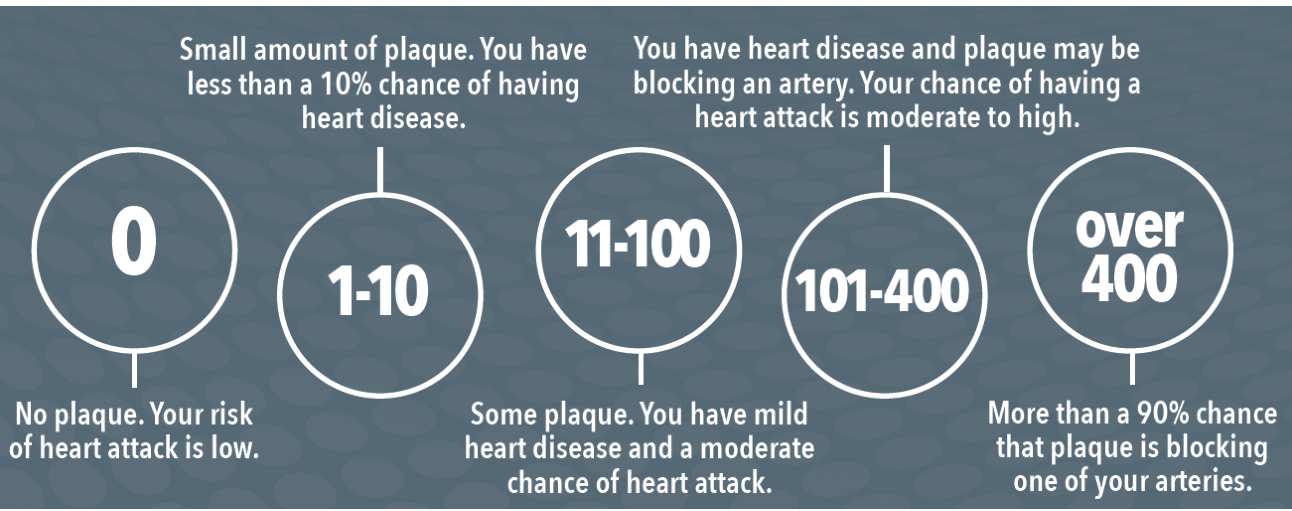
A CT Calcium Score is a non-invasive test that uses a CT scan to measure the amount of calcified plaque in your coronary arteries. This test measures your “calcium score," which helps your doctor calculate your risk of developing coronary artery disease (CAD) and related cardiac issues such as a heart attack or a stroke. It helps determine the best course of action—such as medication or lifestyle changes—to reduce your risk of a heart attack or other heart problems.
What does a Calcium Score show that other tests don't?
A CT Calcium Score measures the amount of calcium within plaque in the coronary arteries—plaque that cannot be directly visualized through other non-invasive methods. Because the arteries of the heart are up to five times more likely to develop plaque than those of other organs, this test can provide valuable insight into whether you are prone to plaque buildup. As a result, a heart CT scan may also help predict the risk of plaque-related disease in other parts of the body.
Different Types of Nuclear Medicine Exams and What They Evaluate
If you’re scheduled for a nuclear medicine exam, it’s important to understand what the test…

Different Types of Biopsy and When to Get One
If you have been experiencing any unusual symptoms, it is important to see a doctor…

Different Types of Ultrasound Exams and What They Evaluate
Ultrasound exams are a common diagnostic tool used by doctors to look at the inside…

Musculoskeletal Pain
If you are experiencing musculoskeletal pain, you are not alone. Many people suffer from this…

May: American Stroke Awareness Month
Strokes are an unfortunately common medical emergency that can cause long-term impairment and even death.…
Why Choose Zwanger-Pesiri?
Zwanger-Pesiri Radiology brings world-class expertise to the Long Island community. Our subspecialty-trained radiologists are Board Certified by the American Board of Radiology with fellowship training in a variety of specialties. They are highly-skilled, highly-knowledgeable, and make patient care a priority. To learn more, contact us today.